
Compliance that lasts – no matter what comes next.
One platform for ISO 27001, GDPR, NIS2, the EU AI Act, and more. Set up your processes once, reuse them across frameworks, and bring in qualified experts whenever you need them.

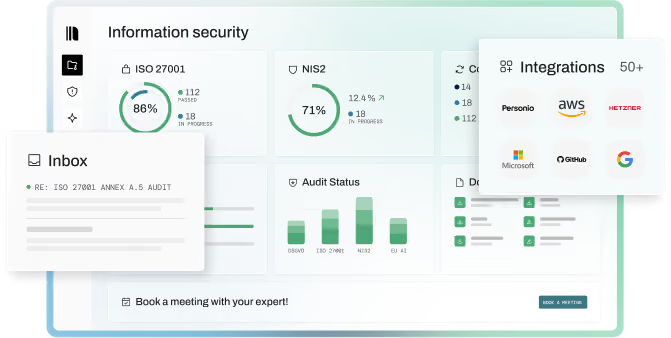












A system for businesses that think ahead

Everything on one platform – from information security to AI governance
ISMS / ISO 27001
Build a structured ISMS and manage requirements, controls, and evidence centrally.
Asset Management
Record systems, devices, and responsibilities to create a solid foundation for your risk assessment.
Vendor Management
Evaluate service providers, document risks, and keep track of contracts, evidence, and certificates.
NIS2 Compliance
Map NIS2 requirements to specific measures and document their implementation in a transparent way.
Policy Management
Create, assign, and update policies centrally.
No security team of your own?
Our experts support you with implementation, audits, and communication with authorities.

EU AI Act
Register AI systems, classify risks, and document the necessary measures in accordance with the EU AI Act.
Whistleblower System
Provide a secure reporting channel and manage disclosures in a structured, confidential, and traceable manner.
Compliance Audit
Assess your current status, identify gaps, and determine concrete next steps.
Compliance Training
Train employees on data protection, information security, AI, and other relevant topics.
Integrations
Connect heyData to your existing tools and transfer information without redundant data entry.
AI governance without the guesswork.
We help you make AI usage transparent and clearly define responsibilities.
GDPR compliance
Manage directories, risks, requests, and evidence in one central location.
UK GDPR
Manage data protection requirements for the United Kingdom within the same platform.
revFADP
Implement the requirements of the Swiss Data Protection Act in a structured and transparent way.
Data Protection Impact Assessment
Run and document required risks in one place.
Documentation & TOMs
Document technical and organizational measures and keep your records up to date at all times.
Data protection that doesn't end up in a folder.
Automate recurring tasks and keep track of responsibilities, deadlines, and documentation.
External Data Protection Officer
Get a dedicated contact person who knows your company and provides expert answers to your data protection questions.
Compliance Audits
Get your processes, documentation, and measures independently audited—complete with clearly prioritized recommendations for action.
Platform + Experts
Combine scalable software with personalized support for complex or critical situations.
Compliance for SMEs
Build a robust compliance structure without needing to hire a dedicated data protection or security team.
Compliance for SaaS companies
Meet customer requirements faster, complete security questionnaires more efficiently, and build trust throughout the sales process.
Expertise when it counts.
The platform manages your day-to-day operations. Our experts support you whenever things get complex.
One platform. No consultant chaos.
Others sell you consulting hours. We give you a system that grows with you – backed by real experts whenever you need them.

Multi-Framework Engine
Do the work once, and it counts toward GDPR, ISO 27001, the AI Act, and more. No duplicate effort.

AI-Powered Automation
DPIAs, risk assessments, and policy drafts: the engine handles the heavy lifting, backed by the expertise of our team.

Qualified Experts
A dedicated point of contact from our team – qualified DPOs, infosec specialists, and legal experts who know your setup and stand behind it. No anonymous hotline.


Modular by Design
Start with the framework you need right now. Add more as your needs grow. You only pay for what you actually use.
What companies achieve with heyData
Response time for urgent compliance concerns
"heyData stands out as a high-quality platform that's both pragmatic and solution-oriented."
Estimated cost efficiency vs. an in-house full-time role
"Internally, we couldn't handle this ourselves at our size. With heyData, we're significantly more cost-efficient and always up to date."

less time spent on data protection topics since heyData
"heyData brings clarity, security, and a level of support that makes it possible to stay compliant without losing focus on what matters most."


Is your compliance ready for whatever comes next?
In a 30-minute demo, we'll show you how heyData fits into your existing processes, frameworks, and responsibilities.
Free & no obligation
Securely developed. Operated in Germany.

Compliance software handles sensitive information. That is why security at heyData is not an add-on feature, but part of our technical foundation.
Encryption & Access Control
Encrypted data, strictly regulated access.
European Provider
German company, European law, no access by non-EU authorities.
Regular Security Audits
Continuously tested and securely maintained.
Certified Experts
Deep expertise in information security, data privacy, and AI compliance.
Understand compliance. Make confident decisions.
Practical content on ISO 27001, NIS2, GDPR, the EU AI Act, and other requirements – clearly explained and ready to use.

Whitepapers & Guides
Compliance Blog

Studies & Reports
Customer Stories

Lay the groundwork today for tomorrow's requirements.
Start with the framework you need today. Add more as your business grows or new requirements come into play.