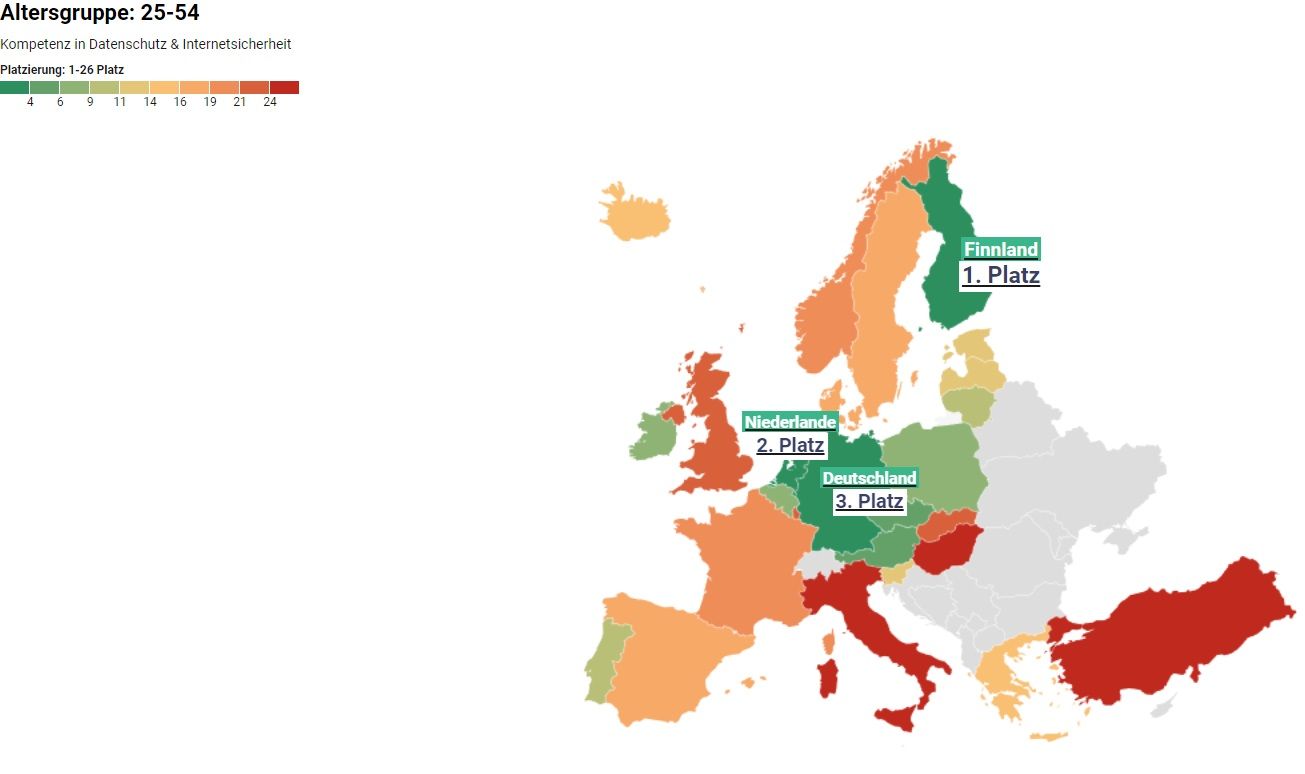
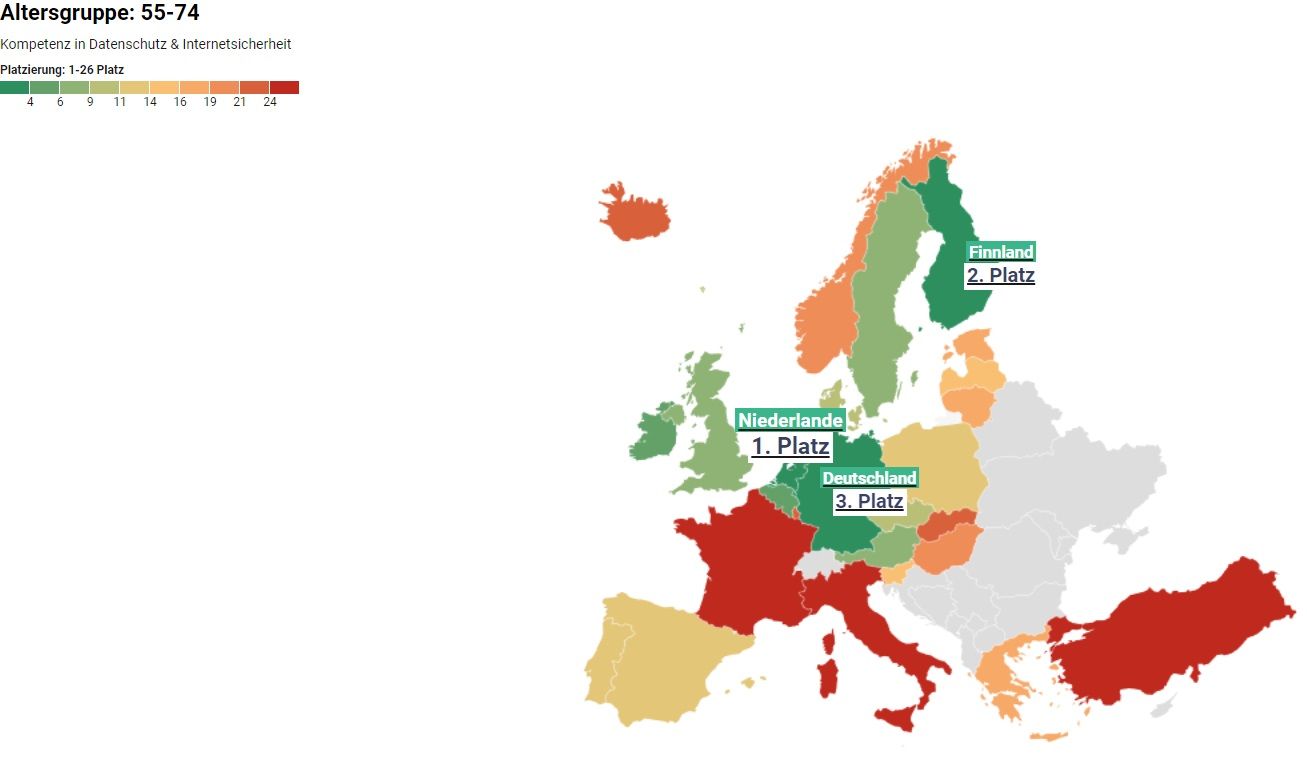
Due to steadily increasing digitalization, the GDPR was introduced as an EU regulation in 2018. Standardized data protection is meant to ensure that internet users have full control over how their data is used. Companies and private individuals across Europe had to adapt to these measures and rules to make the internet a safer place. How well people in Europe have adapted to the GDPR reveals how security-conscious and internet-savvy people in the different countries of Europe are. heyData conducted a study to find out which European countries are the safest online, highlighting the differences between countries and age groups. Using data from the Organisation for Economic Co-operation and Development, we examined the EU countries as well as Norway, Turkey, Iceland, and the United Kingdom, and analyzed the following age groups: 16-24, 25-54, and 55-74.
The Study Focuses on the Following Factors to Identify Security-Conscious and Internet-Savvy People:
- People who had no virus on their PC in the last three months
- People who were not affected by phishing
- People who use anti-tracking software
- People who have experienced no breaches of their personal data or privacy violations
- The level of people's privacy settings on social media
- People who protect their personal data from advertisers
- People who were not affected by payment fraud
- Whether a person prevents or restricts cookies
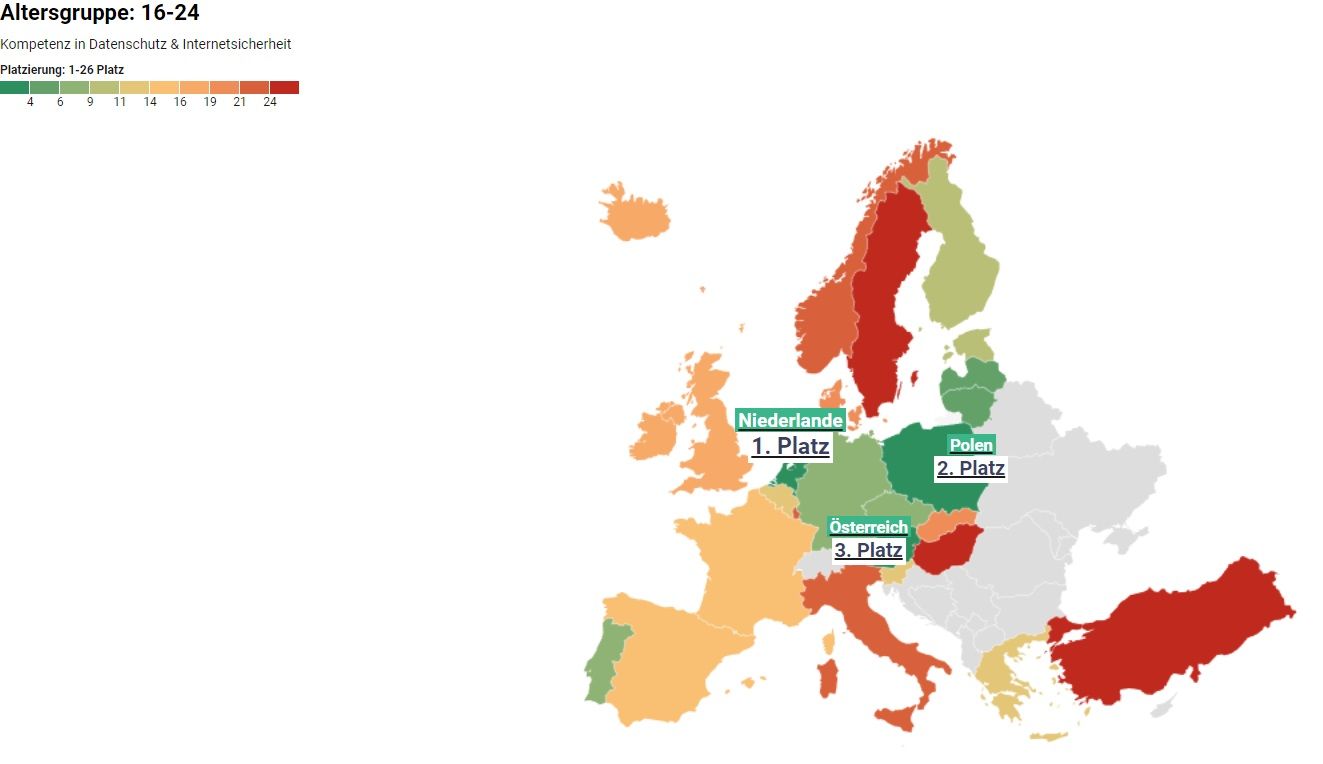
Based on these factors, we were able to create a ranking that shows where people are safest online.
Age Group
16-24
25 - 54
54 - 74
Results and Evaluation
To calculate a ranking, all results of the examined influencing factors were normalized. For this purpose, points on a scale between 0 and 100 were used. The age group and country that proved particularly advanced in terms of internet savviness for a given influencing factor received a score of 100. The country or age group that proved least advanced in terms of data protection measures for the respective influencing factor received a score of 0.
Then all points from all influencing factors of a research field were added together. The sum produced the research field score. Finally, all eight research field scores were added together, and this final result was also normalized on a point scale between 0 and 100. The normalized final result corresponds to the communicated final ranking.
The calculation was based on the following normalization formula: x new = x – x minx max – x min
Research Field 1: Users Not Affected by Viruses in the Last 3 Months (Computer Malware)
With increasing digitalization, protecting a computer from viruses is a must, and having such protection in place shows how security-conscious users are. A computer virus is a malicious program or code that changes the way a computer works and can spread from computer to computer. The virus can attach itself to a legitimate document or program.
This research field examined how many people had no virus on their computer in the last three months. The data for this was taken from the Organisation for Economic Co-operation and Development. The lower the score, the better users protect themselves with antivirus software.
Research Field 2: People Not Affected by Misuse of Personal Data or Privacy Violations (Personal Data)
The misuse of personal data can take numerous forms, such as the loss of personal data or the sharing of data with unauthorized recipients. A data protection breach is broadly defined as a security incident that compromises the integrity, confidentiality, or availability of personal data. A data breach occurs when personal data is destroyed, lost, damaged, or disclosed, or when it is shared without authorization or made inaccessible.
A lower score in this area reflects a high level of security awareness. The data was taken for the last three available months and comes from the Organisation for Economic Co-operation and Development.
Research Field 3: People Who Have Not Suffered Financial Losses Due to Fraudulent Payments (Payment Fraud)
With increasing digitalization, protecting a computer from viruses is a must, and having such protection in place shows how security-conscious users are. A computer virus is a malicious program or code that changes the way a computer works and can spread from computer to computer. The virus can attach itself to a legitimate document or program.
This research field examined how many people had no virus on their computer in the last three months. The data for this was taken from the Organisation for Economic Co-operation and Development. The lower the score, the better users protect themselves with antivirus software.
Research Field 4: People Not Affected by Phishing (Phishing)
Phishing is an attack on a computer aimed at stealing data such as credit card numbers or login credentials. The attacker poses as a trustworthy entity and tries to get victims to open an email, text message, or instant message and reveal sensitive data such as bank details or passwords.
A low score stands for a high level of knowledge about phishing and the use of appropriate protective measures. The data comes from the Organisation for Economic Co-operation and Development and refers to the last three months.
Research Field 5: Privacy Level of Social Media Profiles (Social Media)
This field examined data protection literacy regarding social media profiles and content. A high level of data protection prevents personal information from being viewed by companies, users, or unauthorized third parties.
Research field 1: Users not affected by viruses in the last 3 months (computer malware)
The aim of the study is to find out which countries and age groups are the most internet-savvy. The study examined the countries of the European Union as well as Norway, Turkey, Iceland, and the United Kingdom.
Bulgaria, Croatia, Malta, Cyprus, and Romania had to be excluded from the study due to insufficient data and to allow a fair comparison between all countries.
For the study, all countries were analyzed across the following eight research fields: internet users who were not affected by viruses in the last three months, who were not affected by misuse of personal data or privacy violations, who did not suffer financial losses due to fraudulent payments, and who were not affected by phishing, as well as the privacy level of social media profiles, browser settings to prevent or restrict cookies, the use of anti-tracking software, and the protection of personal data from advertisers.
All influencing factors were selected based on how meaningfully they reflect objective security when using the internet.
The ranking was compiled by age group (16-24, 25-54, and 55-74), gender, and country.
The result is a ranking of the leading nations, age groups, and genders in terms of internet security and savviness.