The 100 Biggest Spy Apps at a Glance
Where were you in 2007? In January of that year, there was a revolution in the world of technology: a new product was launched that changed the way we live our lives and the way companies collect information about us. The iPhone was released and immediately generated immense hype thanks to its numerous functions (phone, music player, web surfing, etc.). People were thrilled by the compact mobile device, and thanks to further developments and more providers, smartphones have become impossible to imagine life without: around 80% of the world's population owns one today.
Mobile phone applications — or (mobile) "apps" for short — existed before the iPhone, but they only multiplied rapidly after the smartphone's release. An app is a type of software mostly associated with running on mobile devices such as smartphones or tablets. Some apps are merely copies of popular websites adapted to smartphone displays, while other apps are standalone, completely new programs. When Apple opened its App Store in 2008, there were just 500 mobile applications for iPhone users. Today, there are more than 2.2 million. In the same year, Google launched its own app marketplace, Google Play, which today offers around 3.5 million apps. More than 90% of these apps are available for free.
If the Product Is Free, You Are the Product
Everyone who uses apps pays a hidden price: the price of their own personal data. As we use them in our daily lives, apps collect information about us that they can use or resell. From browser history to phone contact lists, little information is safe from them. The personal data that applications collect about us can, for example, help third parties better understand their target audience and reach them with targeted advertising messages. As experts in data protection, the team at heyData wanted to find out which mobile apps spy the most and lead the pack when it comes to gaining access to personal data.
Apps do, however, have to ask for permission to access our personal data. Many app users, though, aren't aware of when this happens. If you accept an app's terms and conditions without reading them, you may already be granting permission to access your personal data. In other cases, nicely worded pop-ups such as "We value your privacy" or "Help us improve" may actually be an app's access request, granting it permission to use your personal data. By analyzing hundreds of popular, freely available apps on Google Play, we found out which apps in Germany make the most requests to access personal data. The result is the list of top spy apps!
For the full table and deeper analysis, click on the image or links. We identified top spy apps in Germany by analyzing popular apps in the Google Play Store:
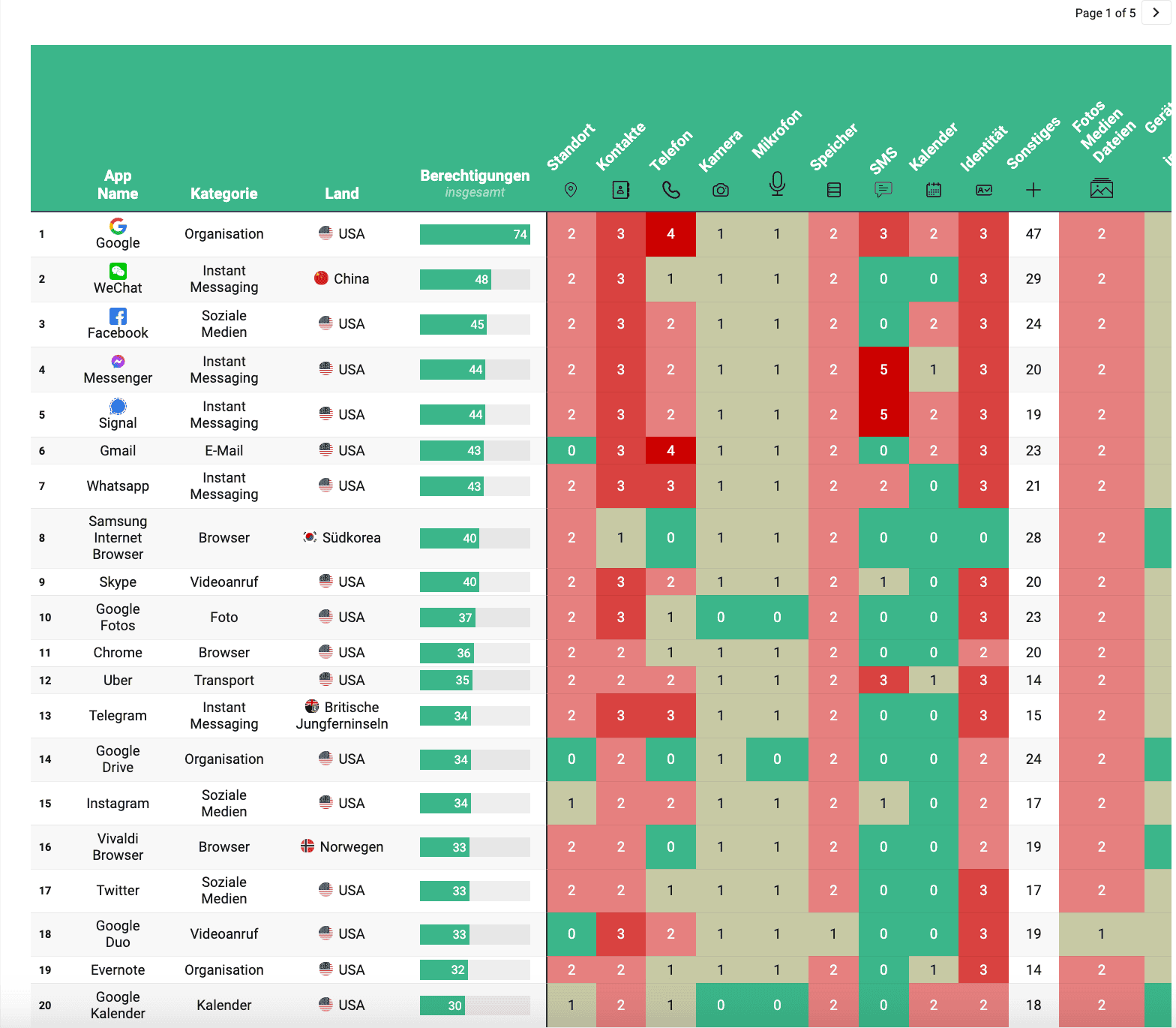
Source: heyData Embed Created with Datawrapper
Our Approach for the Ranking
The aim of the study was to find out which apps make the most requests to access personal data. In April 2022, we examined 250 of the most popular apps freely available in Germany in the Google Play app store, including apps for social media, fitness, dating, music, news, and transportation. For every available mobile application offered on Google Play, there is a corresponding landing page on play.google.com. On these landing pages, you can find further information about the app, including the data the app requests permission to access. This information can be found under the "Permissions" section.
We then recorded all the different permission requests, with the apps making the most access requests considered the apps that spy the most. The list of 250 apps was narrowed down to a final list of 100 in total, which is ultimately available here.