
How do you build a compliance strategy that stands the test of new regulations?
Governments change, political priorities shift, and draft laws are tightened, delayed, or revised. What is being negotiated today as groundbreaking regulation at the European or national level can be adjusted tomorrow by new political majorities or supplemented by new initiatives.
Many companies get trapped in a permanent reactive loop: as soon as a new directive like NIS2 or the EU AI Act hits the headlines, or customers demand new audit evidence, a new special project is hastily launched. New consulting mandates are issued, isolated software tools are purchased, and document silos are created.
The result is compliance fatigue – characterized by immense duplication of effort and high costs.
But there is another way. A future-proof compliance management strategy is not guided by political cycles, but by the company's actual risks and business processes.
The core message: Your obligations may change. Your compliance foundation shouldn't have to.
Can a compliance strategy really be politically independent?
To avoid any misunderstandings: Being politically independent does not mean ignoring current laws or new regulations. Laws remain binding and must be fully complied with.
What remains independent of politics is your operational compliance infrastructure.
Instead of building an entirely new system for every legislative change, forward-thinking companies create a solid foundation of processes, responsibilities, and controls. When legislation changes, only specific requirements change - not the foundation itself.
The two levels of a sustainable compliance strategy
- The stable foundation (infrastructure): Risk management, roles and responsibilities, asset and data inventories, vendor risk management, incident response, training, and centralized evidence management.
- The variable layer (regulatory layer): Concrete legal thresholds, specific reporting deadlines, technical documentation, and additional certification-related requirements.
New laws may change the rules, but once your infrastructure is in place, you can simply roll out regulatory updates like a software update - without having to replace the hardware.
Which compliance processes remain the same despite new laws?
Whether it's data protection (GDPR), cybersecurity (NIS2), information security (ISO/IEC 27001), or artificial intelligence (EU AI Act): the fundamental organizational and technical building blocks for securing a company overlap to a large extent.
The following overview shows how a compliance infrastructure, once established, supports both existing and future requirements:

Don't miss an update.
New laws, deadlines, and practical tips delivered straight to your inbox – once a month, no spam.
Which compliance requirements overlap between GDPR, NIS2, and ISO 27001?
A key advantage of infrastructure-oriented multi-framework compliance is the consistent avoidance of redundancies. Those who view regulation in silos often end up conducting three different risk analyses and two separate vendor assessments.
A look at regulatory practice reveals massive overlaps:
- Risk-based approach: The GDPR (Art. 32) requires appropriate technical and organizational measures (TOMs) based on the risk to data subjects. NIS2 explicitly mandates that affected entities implement risk-based cybersecurity management. ISO/IEC 27001 is built at its core on a continuous Information Security Management System (ISMS) that is primarily risk-driven.
- Supply chain & third-party security: All three regulatory frameworks require strictly controlled integration of service providers. By implementing a robust Vendor Risk Management system, you simultaneously satisfy the requirements of the GDPR (Data Processing Agreement), NIS2 (supply chain security), and ISO 27001 (A.5.19-5.23 Supplier Relationships).
- Practical example: EU AI Act The Artificial Intelligence Act also employs a risk-based approach. A company that already maintains an asset inventory and a structured risk assessment only needs to add the specific classification (e.g., high-risk vs. low-risk) for the use of AI tools, rather than launching an entirely new AI governance project.
Reactive Compliance vs. Compliance-as-Infrastructure
The following comparison illustrates the strategic shift from being driven by reactive projects to building a scalable infrastructure:
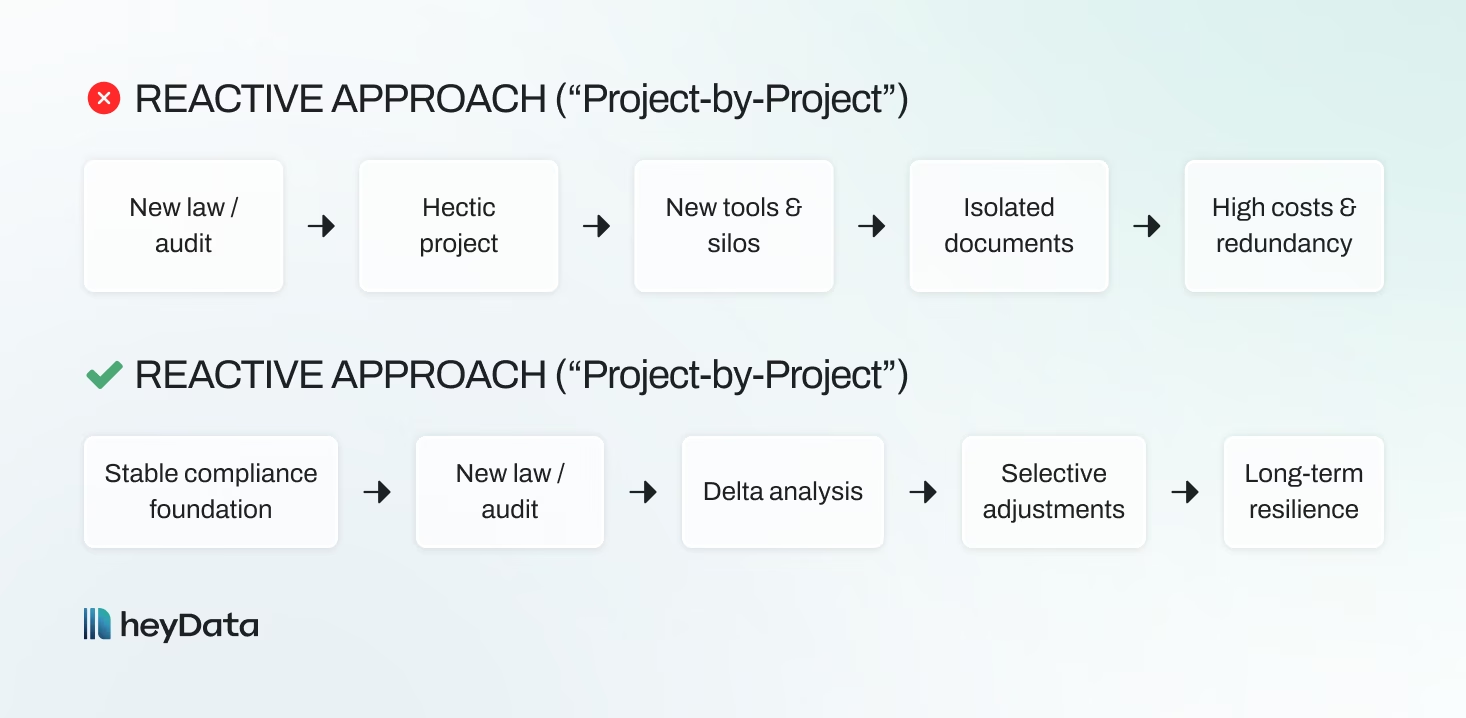
- The reactive approach asks: "What exactly does the new law require of us, and what new document do we need to create for it?"
- The infrastructure approach asks: "What controls, evidence, and processes do we already have - and which new variables do we need to integrate into our existing system?"
How do you prepare for future regulations?
To build a Compliance Management System (CMS) that can withstand future political or legal developments, companies should follow these four steps:
- Build a central risk and asset register: Primarily record which data, IT systems, and business processes are critical to your company—regardless of the name of the current law.
- Establish cross-framework controls: Focus on measures required by almost every standard: access concepts, encryption, incident response, backup strategies, and recurring training.
- Centralize evidence management: Ensure that audit evidence (e.g., training certificates, DPA contracts, penetration tests) is centrally accessible and updated automatically.
- Establish delta audits: Instead of viewing new legislation as the starting signal for a massive project, the legal or compliance team should conduct a targeted delta analysis: "What 10% of new requirements are missing from our 90% baseline?"
Conclusion: Lasting resilience instead of constant project stress
Laws and political majorities will continue to change. Companies that rebuild their compliance strategy from the ground up with every new legislative initiative waste valuable resources and hinder their own agility.
With the "Compliance as Infrastructure" approach you transform regulatory requirements from a tedious chore into a strategic competitive advantage. You build an infrastructure that is set up correctly once - and then remains reliable.
How heyData supports you
With the all-in-one compliance platform from heyData you consolidate data protection, information security (ISO 27001, NIS2), and AI governance on one central platform. Turn compliance into a sustainable infrastructure: built once, protected permanently - regardless of what regulatory changes the future brings.
Data Protection for Companies: GDPR Beginner's Guide | heyData
Learn the key GDPR basics for companies — from mandatory documents and technical and organizational measures to DPAs, data subject rights, and data breaches.

Free & no obligation
FAQ
Is a centralized compliance infrastructure affordable for small and medium-sized enterprises (SMEs)?
Is a centralized compliance infrastructure affordable for small and medium-sized enterprises (SMEs)?
Yes, absolutely. Especially for mid-sized companies (25 to 500 employees), the infrastructure approach is significantly more cost-effective than repeatedly buying isolated consulting projects and standalone solutions for GDPR, ISO 27001, or NIS2. By avoiding duplicate work, SMEs save substantial resources.
How do you prevent losing track of things with a multi-framework approach?
How do you prevent losing track of things with a multi-framework approach?
The key lies in a centralized management platform that maps requirements from different frameworks to common controls (cross-framework mapping). For example, a completed training session or a set up two-factor authentication is automatically credited as proof for GDPR, ISO 27001, and NIS2 at the same time.
What happens if a new regulation introduces completely novel obligations?
What happens if a new regulation introduces completely novel obligations?
A good compliance infrastructure is modular. If a new regulation demands specialized obligations (such as the conformity assessment for high-risk AI systems under the EU AI Act), it simply integrates as a new module into the existing governance, risk, and documentation structure.
Which standard is best suited as the foundation for a multi-framework strategy?
Which standard is best suited as the foundation for a multi-framework strategy?
A proven combination is a solid foundation based on GDPR requirements for data protection, combined with ISO/IEC 27001 best practices for information security. Anyone who has anchored these two pillars automatically covers the vast majority of future regulations like NIS2, DORA, or the EU AI Act.